If you’re running a business in 2026, chances are you’ve faced this question:
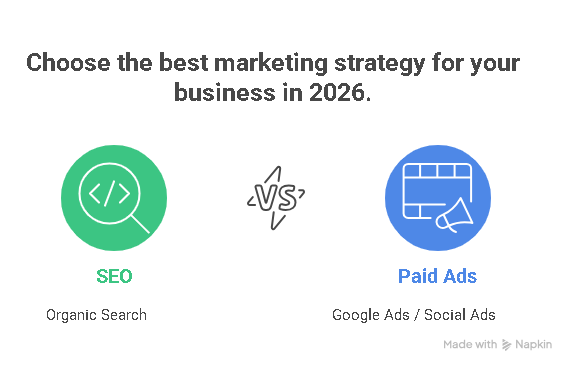
Should I invest in SEO or run paid ads?
Both options can bring traffic, leads, and sales. But they work very differently, and choosing the wrong one for your situation can waste time and money.
This guide explains the real differences between SEO and paid ads, when each one makes sense, and how businesses should think about them in 2026.
SEO, or search engine optimization, is the process of improving your website so it appears in organic search results on Google when people search for your services.
SEO is not about quick wins. It focuses on:
Long-term visibility
Building trust with search engines
Creating useful content
Improving website structure and performance
Attracting users who are actively searching for solutions
When SEO works, your website continues to attract visitors without paying for every click.
Paid ads, such as Google Ads or social media ads, allow your business to appear instantly at the top of search results or in social feeds.
Paid advertising is effective for:
Immediate visibility
Launching new products or services
Testing offers quickly
Short-term campaigns
However, the moment you stop paying, the traffic stops.
Paid ads rent attention. SEO builds ownership.
One of the most important differences between SEO and paid ads is user intent and trust.
People clicking organic search results often:
Trust them more than ads
Are researching or comparing options
Paid ads can attract high-intent users, but many people still skip ads and scroll to organic results. In competitive industries, trust plays a major role in conversions.
Takes time to show results
Builds long-term visibility
Improves website quality and trust
Brings consistent traffic over time
Lower cost per lead in the long run
Delivers immediate traffic
Requires continuous budget
Costs increase with competition
Stops working when ads stop
Useful for short-term goals
Neither is “better” in all cases. The right choice depends on your business stage and goals.
For most small businesses, especially service-based businesses, SEO is usually the stronger long-term investment.
SEO helps:
Build credibility
Attract local and organic leads
Reduce dependency on ad spend
Compete with larger companies over time
Paid ads can still be useful, but relying only on ads often becomes expensive and unstable.
Paid ads are a good choice when:
You need immediate leads
You’re launching something new
You’re running time-sensitive promotions
You want to test offers or landing pages
You already have strong conversion tracking
In these cases, ads provide speed and control.
In 2026, search engines prioritize:
Helpful content
Real expertise
Trust and authority
User experience
Clear intent matching
SEO is no longer about keywords alone. It’s about building a reliable digital presence that search engines and users trust.
Businesses that invest in SEO now are building an asset that grows over time, instead of paying higher ad costs every year.
The best strategy for many businesses is not choosing one over the other, but using both wisely.
A balanced approach looks like this:
SEO for long-term growth and authority
Paid ads for quick visibility and testing
SEO-optimized landing pages for ads
Data from ads used to improve SEO strategy
This combination reduces risk and improves overall performance.
Some common mistakes include:
Expecting SEO to work instantly
Spending heavily on ads without conversion tracking
Running ads to poor landing pages
Ignoring SEO because ads feel easier
Choosing based on cost instead of strategy
Good decisions come from understanding how each channel works, not from trends or promises.
Ask yourself:
Do I need results now or long-term stability?
Do I want to rent traffic or build an asset?
Is my website ready to convert visitors?
Can I support ongoing ad spend?
If you want sustainable growth, SEO should be the foundation. If you need speed, paid ads can support it.
SEO and paid ads are tools, not magic solutions. The right choice depends on your goals, budget, and timeline.
In 2026, businesses that rely only on ads face rising costs, while businesses that invest in SEO build lasting visibility and trust.
The smartest businesses understand both and use them strategically.
If you’re unsure whether SEO, paid ads, or a combination is right for your business, a clear strategy can save you time and money.
Choosing the right channel is not about trends. It’s about what works for your business.